
Use the charger supplied with your e-bike, charge while you are awake and nearby, and keep the bike or battery away from exits and combustible clutter. Follow your owner’s manual for details such as whether a removable battery may be charged off the bike and what temperature range is allowed. In the United States, CPSC guidance says to use the supplied charger, stay present, never charge while sleeping, and unplug when finished.
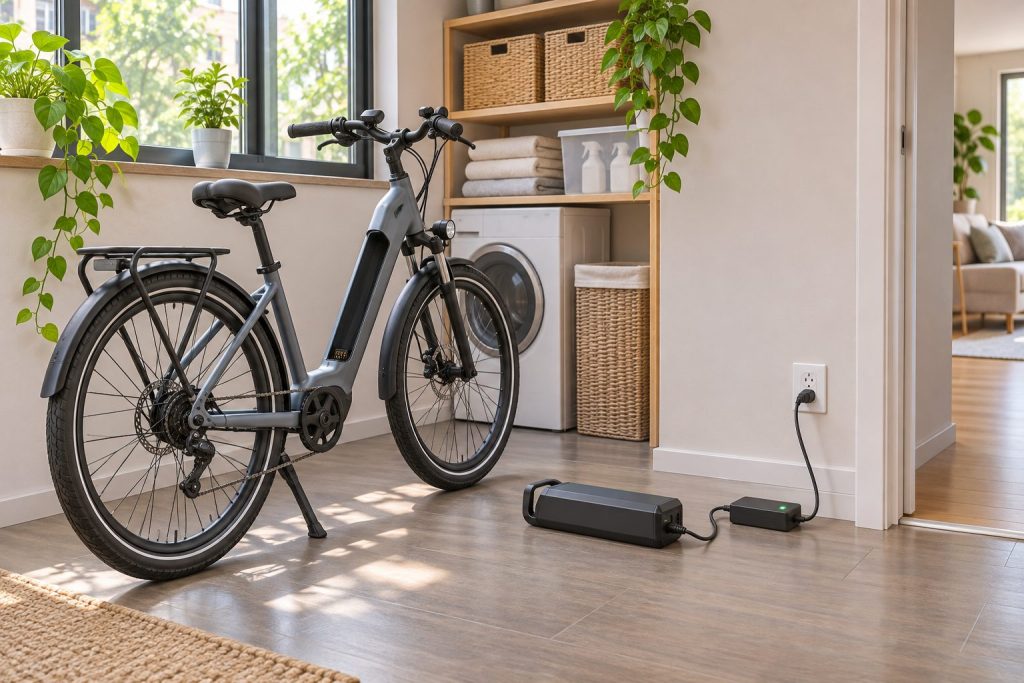
Choose a safe charging spot
Set the bike or battery on a stable surface in a clear area. Keep it away from bedding, sofas, paper, curtains, direct heat, and other things that can burn. Do not block a doorway or your main route out. If the battery is removable, take it off and charge it only as the manufacturer directs; do not improvise a setup on a bed or soft furnishing.
New York City Fire Department guidance recommends charging directly from a wall outlet, away from exits and hallways, and avoiding extension cords and power strips. It also says to keep combustible items out of the charging area. These are useful precautions, but building and fire rules can differ by location. If your home has no suitable spot, ask your building whether it provides an approved charging area.
Match the charger to the battery
Use the original charger. If it is lost or damaged, contact the bike maker or an authorized dealer for a replacement confirmed to work with your exact model. A plug that fits does not prove that the charger is compatible: CPSC warns that chargers marketed as “universal” or for broad categories of e-bikes can have different charging requirements and may cause a fire.
When buying an e-bike, third-party certification can be one useful safety check. UL 2849 evaluates combinations of the bike’s electrical drive, battery, and charger systems. A certification mark on an individual battery or charger does not by itself mean the complete e-bike electrical system has been certified to UL 2849. Certification does not replace the manufacturer’s charging instructions.
Stay nearby and unplug when done
Charge at a time when you can remain present and keep an eye on the bike or battery. CPSC advises against charging while asleep and says to unplug when charging is complete. Follow your manual for the expected charge cycle and any cooling period after a ride; avoid making overnight charging part of your routine.
For example, after an evening commute, check the manual before charging a warm or cold battery, start charging when you can stay nearby, then disconnect it when the cycle is complete. If your schedule would leave the battery charging while you sleep or are away, choose another time or a suitable charging facility approved by your building.
Stop if the battery is damaged or acts unusually
Do not charge a damaged battery. The FDNY lithium-ion safety guide says to stop using a battery that gets hot while charging; if it starts to expand or emit smoke, leave immediately and call 911 from a safe place. Do not stay to move a smoking battery or attempt to repair it. For other warning signs or uncertainty, stop using the battery and contact the manufacturer or a qualified service provider.
Never open, modify, or try to repair a battery yourself. CPSC also advises using only an approved replacement battery pack and warns against batteries modified by unqualified personnel or built with repurposed or used cells.
Storage between rides
When the bike is not charging, store the battery as its manual directs, away from heat, direct sun, and combustible clutter. Charging and storage temperature limits vary by battery, so use the maker’s guidance instead of a generic temperature rule. Our e-bike battery maintenance guide covers longer-term care, and the winter riding guide discusses cold-weather considerations.
Before charging, make four quick checks: the charger is the right one, the area is clear and away from exits, you can stay nearby, and the battery is not damaged or behaving unusually. This routine supports safer everyday charging while leaving model-specific details to the manual and local fire guidance.
Research-based editorial guide. Prepared with AI assistance and source checks; no hands-on product testing is claimed.

