
Choose an e-bike that can cover your full commute on the days you need the most assistance, with charge left for a detour or missed workplace charge. Start with your actual route distance, then consider hills, cargo, weather and how you ride. A manufacturer’s “up to” range is an advertised figure, not a promise for every commute.
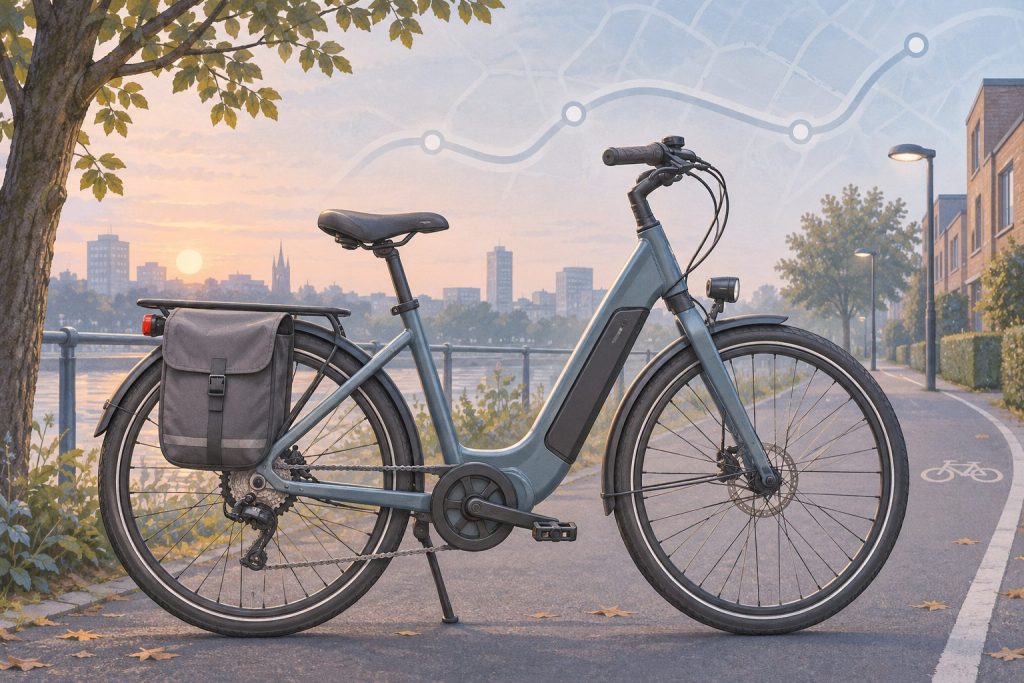
For example, a 6-mile ride each way means 12 miles between charges if you ride home without plugging in. If that route is hilly, you carry a loaded bag or prefer strong assist, a bike rated for just over 12 miles leaves little room for variation. There is no universal reserve percentage: routes, riders and bike systems differ.
What battery watt-hours tell you
Battery capacity is usually listed in watt-hours (Wh). It indicates stored energy, not a guaranteed travel distance. More capacity generally gives the motor more energy to draw on, but can add weight and cost. Range also depends on motor efficiency, assist setting, rider and cargo weight, terrain, wind, temperature, speed and stop-start riding.
That is why two bikes with similar capacities can deliver different ranges on a particular trip. Trek currently lists its Verve+ 1 with a 250 Wh battery and an advertised “up to” range of 35 miles, and its Verve+ 2 with a 400 Wh battery and an “up to” range of 50 miles. Those figures describe specific models; they are not independent measurements or guarantees for your route.
When comparing bikes, look beyond the largest range number on a product page. Check the conditions behind the estimate and whether the maker’s calculator supports your system and route. Bosch offers an interactive range tool. Bosch’s Range Control feature can estimate remaining charge at arrival using information such as system weight, route elevation and your riding style. These are planning aids; weather and riding choices can still change actual results.
Estimate your real commute
- Add the whole trip. Include both legs and the detours you normally make. If you can recharge at work, you can assess each leg separately, but consider whether that outlet will reliably be available.
- Use the route you will ride. A flat, steady path differs from a steep route with frequent starts. Use the actual commute, not just the shortest line between home and work.
- Be realistic about assist. Lower assist usually uses less battery; higher assist uses more. Consider the setting you will want when tired, carrying groceries or riding into a headwind.
- Count your load. Work gear, groceries or a child seat add weight. A bike that has ample range unloaded may feel tight once equipped for your everyday trip.
- Consider the difficult season. Cold temperatures can affect battery performance. If you ride year-round, think about the colder or windier conditions you expect, not only a mild-weather ride.
How much extra range is enough?
Treat a range estimate as a way to compare options, not an exact prediction. Aim for a bike that leaves a practical reserve for an unplanned errand, a missed charge or conditions that use more energy than expected. If you routinely arrive nearly empty, the setup may be too close to your minimum need even if the advertised maximum looks ample.
If a shop offers a demo, try your route on the specific bike. Note the distance, assist mode, terrain and battery reading at the end. One ride is not a universal range test, but it gives you a useful reference for your conditions. If a demo is not possible, ask the seller or manufacturer for an estimate using your route and load, and treat the answer as an estimate.
A larger battery can provide flexibility for longer rides or less frequent charging. The tradeoff is added weight, which matters if you carry the bike upstairs or lift it onto transit. For a short, predictable commute with reliable charging, a smaller battery may suit you better than paying for capacity you rarely use.
Check support and charging guidance
Before buying, confirm whether the battery is replaceable or replacement support is available, and ask about likely replacement cost. A proprietary system may limit future options to compatible parts and the maker’s service network.
In the United States, the Consumer Product Safety Commission says compliance with relevant UL standards significantly reduces the risk of injuries and deaths from micromobility fires, and urges manufacturers to demonstrate compliance through accredited-laboratory certification. If a seller makes a certification claim, ask what documentation applies to the complete e-bike electrical system.
For practical charging precautions, see our guide to charging an e-bike battery safely at home. Our winter riding guide covers cold-weather considerations.
In short: choose battery capacity for your routine, not the biggest advertised range. Add the round trip, consider your route and assist habits, then balance a useful reserve against the weight and cost of a larger battery.
Research-based editorial guide. Prepared with AI assistance and source checks; no hands-on product testing is claimed.

