
Usually, but only if your transit agency allows your specific vehicle and the train or bus has room. In the U.S., local transit rules differ by system; intercity rail adds its own size, weight and battery requirements. Check the rules for every agency on your route before you build a commute around bringing your ride onboard.
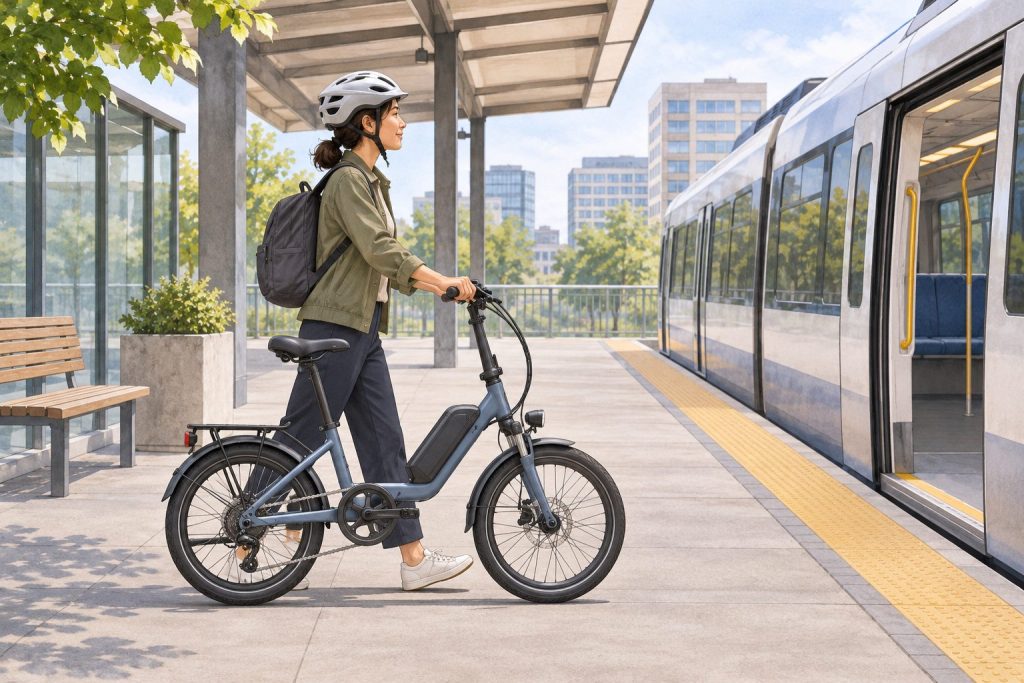
Check these four things before you leave
- Vehicle type: An e-bike, folding e-scooter, non-folding scooter and shared rental may fall under different rules.
- Dimensions and weight: Measure the vehicle as you will carry it, including accessories. A rule for standard bikes may not cover a wide-tire model or scooter.
- How it must be carried: Some systems require scooters to be folded and carried. Agencies may ban riding inside stations, on platforms or onboard.
- Space and timing: Bikes can be refused from crowded cars or limited to certain areas. A rule allowing a bike onboard does not guarantee space on every departure.
Start with the transit agency’s current bike or scooter policy, then check route-specific service alerts and station access. Elevators, fare gates and vehicle storage arrangements can affect whether the transfer is practical.
Local transit rules can differ by vehicle
For example, Washington-area WMATA says bikes and scooters are welcome on Metro Rail and Metro Bus, but bikes must be under 80 inches long, 48 inches high and 22 inches wide. It permits e-bikes, bars gas-powered bikes, and advises riders not to ride inside stations or on trains. The agency also asks cyclists to use elevators and try less-crowded end cars.
BART in the San Francisco Bay Area allows Class 1, 2 and 3 e-bikes under its bike rules. Its policy treats scooters differently: electric scooters must be folded and carried to be brought into stations and trains, while shared app-based rental scooters are not allowed inside. BART says not to board a car that cannot comfortably fit you and your bike; waiting for a less crowded train may be necessary.
These examples are not national rules. Confirm the current policy with your local bus, subway or commuter rail operator, including any restrictions for peak periods, specific stations or particular vehicle designs.
Intercity trains have a separate checklist
Amtrak’s current policy is more detailed than a simple “bikes allowed” rule. It accepts qualifying lithium-ion e-bikes and scooters, but its published requirements include certification for the vehicle and battery by a nationally recognized testing laboratory. Its standard e-bike allowance is up to 50 pounds, with a maximum tire width of 2 inches on most routes; some California routes allow wider tires. Accepted e-bikes must have operable pedals and meet stated motor and speed limits.
Carry-on e-bikes and folding scooters must meet the applicable limits, be powered off, and cannot be charged onboard or on Amtrak property. Folding scooters must be compacted before boarding. Amtrak also says availability depends on train and route; reservations or checked service may be required for some bicycle travel. Read the relevant route details and book any required space before arriving.
Make a realistic transfer plan
Before choosing a vehicle for a transit commute, measure it folded and unfolded, weigh it, and check whether its battery has the certification the operator requires. Save the agency’s policy page on your phone in case staff need to clarify a rule, but follow posted signs and crew instructions.
For the first trip, avoid a connection that depends on squeezing into a crowded car. Allow time to use an elevator, board a later train if needed, or leave the vehicle at a station bike locker when that option is available. Keep doors, aisles, accessible spaces and emergency equipment clear, and never ride the device inside stations unless the agency explicitly permits it.
If you are still deciding whether a transit-assisted ride fits your routine, our guides to estimating e-bike range for a commute and planning an e-bike or scooter commute can help with the other parts of the trip. Policies can change, so recheck the operator’s official guidance before traveling.
Official policies checked November 17, 2026
- WMATA commuter guide: bikes on Metro
- BART Bikes FAQ
- Amtrak special items and electric bike/scooter rules
- Amtrak bicycle service and route information
Research-based editorial guide. Prepared with AI assistance and source checks; no hands-on product testing is claimed.

